Updated 29 August 2026
Charger, board and load as one job
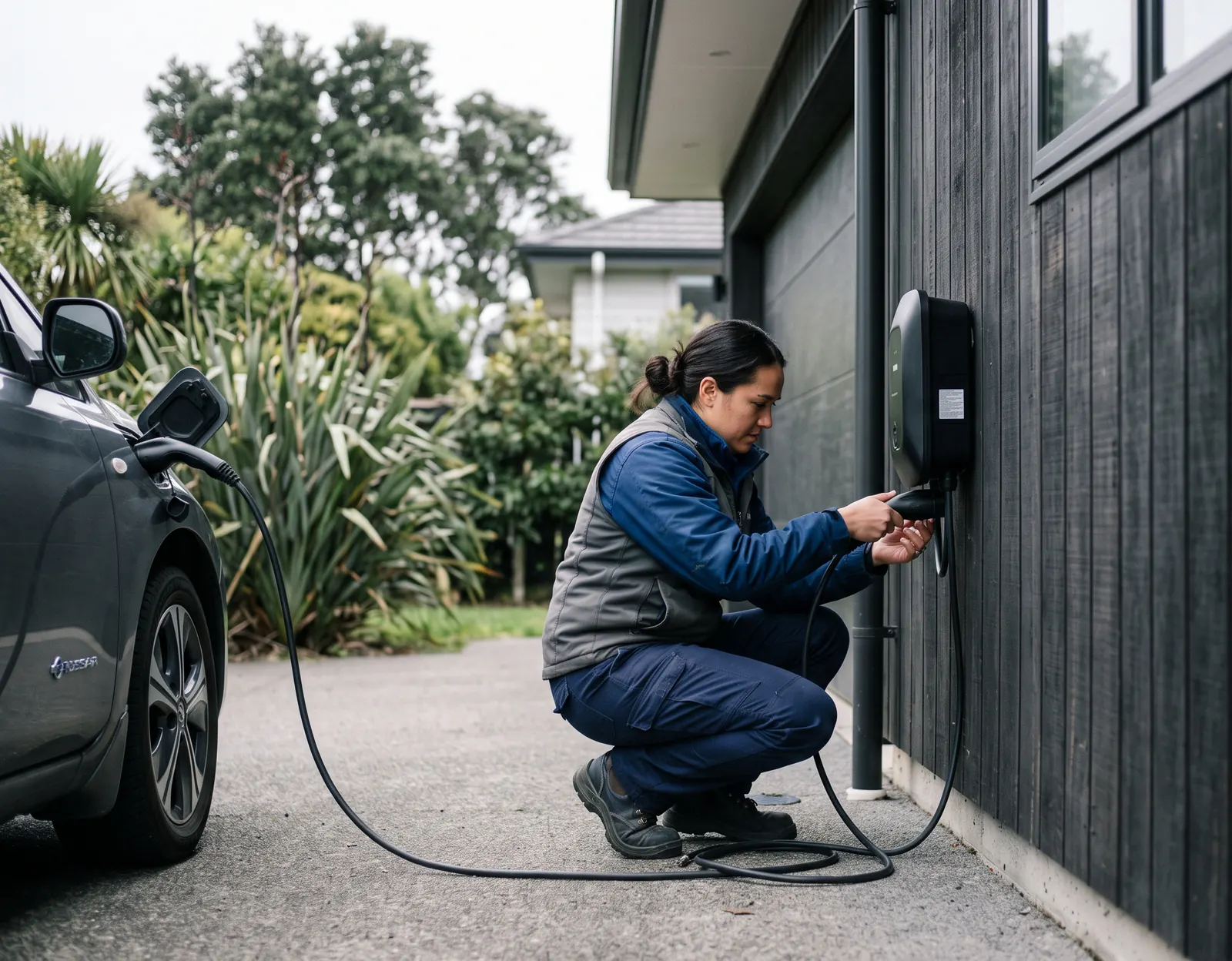
Most bad EV installs are board problems in disguise: a charger clipped onto a board that was already full, on a circuit shared with something it should never share with, with no thought given to what happens when the oven, the heat pump and the car all draw at once. We treat the charger as part of the house’s electrical system, because it is. The switchboard and the load calculation come first, and the quote covers the whole job.
What EV charger installation costs
Across Auckland in 2026, a 7.4 kW wall-box smart charger typically costs $800–$2,500 depending on the brand, and installing it on a dedicated circuit runs $1,500–$3,000 + GST for most homes. Where the switchboard needs upgrading first, allow a further $1,500–$4,000. Long or trenched cable runs, common for villas that park on the street, are the line that moves the number most. The full breakdown, including what moves a quote up or down on the peninsula, is in our North Shore cost guide.
Our quote is different in one structural way: it is fixed before we start. You get a price and a drawing inside two working days covering the charger, the circuit, any board work and the certification. No discovery invoices, and a 12 month workmanship guarantee on the lot.
Every EV charger we install is certified in-house by our own Registered Electrical Inspector. The person who signs the work off is the person responsible for it.
Which charger?
For most homes the right answer is a 7.4 kW single-phase smart charger with load management, so the car yields when the house needs the capacity. We are brand-agnostic, and we install all major brands, including dealer-supplied units and Tesla Wall Connectors. Solar integration matters if you have or want an array on the roof: charging from your own midday generation is the cheapest kilometre you can buy. We will recommend a unit that fits your car, your board and your tariff, or install the one your dealer supplied.
Villas, apartments and street-side parking
Not every house has a tidy garage wall next to the board. Devonport and Cheltenham villas park on the street, with boards that predate RCDs and a cable run that may need trenching before it reaches the car at all. Belmont and Bayswater’s 1960s and 70s homes usually have the garage but not the board capacity. Takapuna apartments share basements and body corporate rules, so metering and load management have to be solved before anything is mounted. Milford’s brick-and-tiles, Northcote Point’s heritage terraces and Birkenhead’s bush-clad driveways each complicate the run in their own way. Awkward installs are Ballard’s specialist-projects DNA: a difficult charger location is a design problem, not a reason to say no.